
Title
Extract the paper title.
Create a structured starting table for literature review and paper screening.
Research teams may need to screen dozens of papers before deep reading. This template extracts bibliographic and review fields while preserving the need for expert interpretation.
Add PDF papers, DOCX files, Markdown notes, or URLs, choose the Scientific paper template, and review one row per primary source by default. Related notes or links can stay with the same row.
The demo uses sample data. You will see how primary sources become rows by default, how related attachments can stay with them, how a template prepares columns, and how to review the result before export.
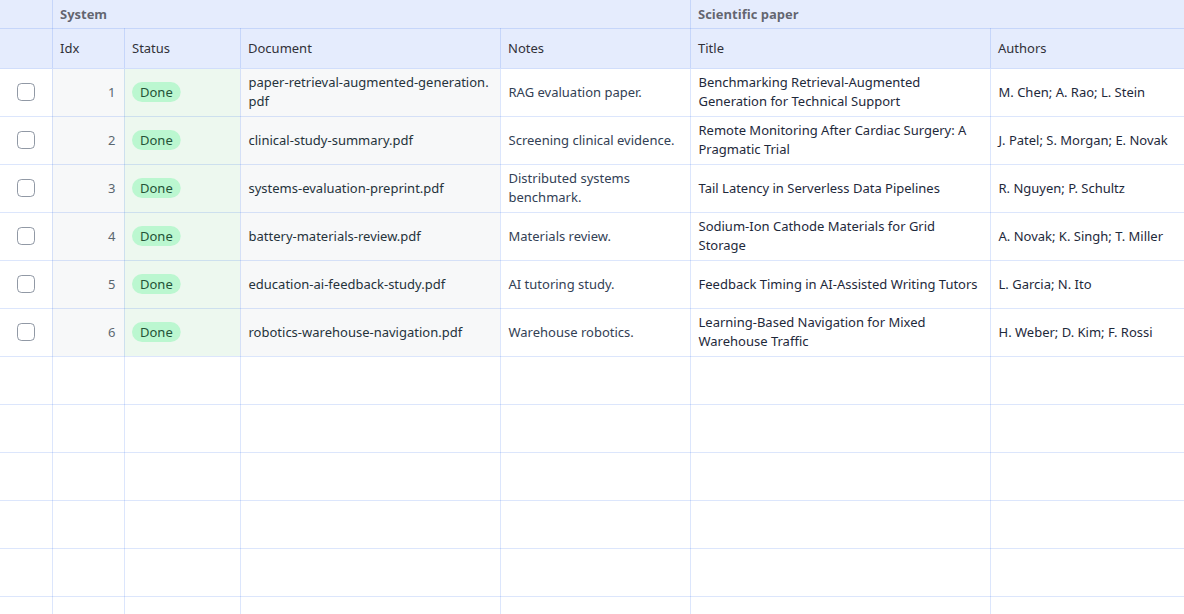
The Scientific papers template prepares columns such as Title, Authors, Year, Venue, Research question. You can adjust the fields or add custom questions.
After sign-in, copy the template to your own templates, rename columns, adjust instructions, and add custom questions. Test it on a few typical sources before using it repeatedly.
Each output column has its own instruction. The examples below are shortened, but they come from the actual built-in template.
Extract the paper title.
Extract the main authors as stated.
Extract the publication year.
The template works well for adding several similar documents or text sources in a batch. Each primary source becomes one table row by default, and related attachments can stay with it.
The sample values are synthetic. Always check important values against the original source.
| Source | Title | Authors | Year | Venue | Research question |
|---|---|---|---|---|---|
| rag-benchmark-paper.pdf | service package | Alpha Ltd | 2026-06-14 | stated in source | stated in source |
| serverless-latency-study.pdf | equipment supply | Beta GmbH | 2026-06-21 | value to verify | value to verify |
| warehouse-robotics-paper.pdf | review overview | Gamma LLC | 2026-07-02 | fill after review | fill after review |
It is a starting setup for processing similar documents or text sources into a table. Rowvia prepares one row per primary source by default, keeps related attachments with it when useful, and creates columns based on this template.
Yes. The template is only a starting point. You can edit, remove, or add columns with your own questions for the fields you need.
Typical fields include Title, Authors, Year, Venue. Important values should be checked against the original source before use.
No. The output is a working table for review and export. Accounting, legal, insurance, public-sector, or technical decisions still require checking important values in the original document.
Open the app, run the demo, or review the workflow this template supports.