
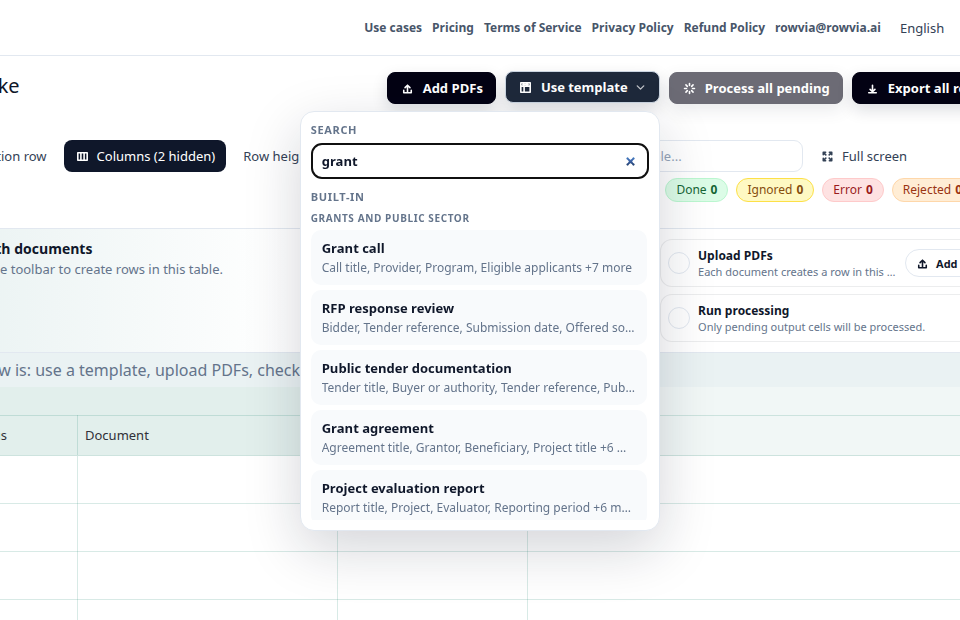
Choose a template
Start with a prepared template for the workflow. The columns and instructions match the selected use case.
Turn tender packs and RFP PDFs into a first review table for scope, deadlines, requirements, and evaluation criteria.
A team is reviewing several public tenders and RFP packs. Deadlines, eligibility rules, submission requirements, and scoring criteria are spread across long PDFs and annexes. Rowvia creates a first review table so the team can decide which opportunities deserve deeper analysis.
Upload tender or RFP PDFs, DOCX files, spreadsheet annexes, or buyer-profile URLs, choose the Public tender documentation template, and review one row per primary opportunity by default. Related annexes or clarifications can stay with it. The table supports triage and handoff; it does not replace procurement or legal review.
Open the tender demoThe demo uses sample data. You will see how primary sources become rows by default, how related attachments can stay with them, how a template prepares columns, and how to review the result before export.
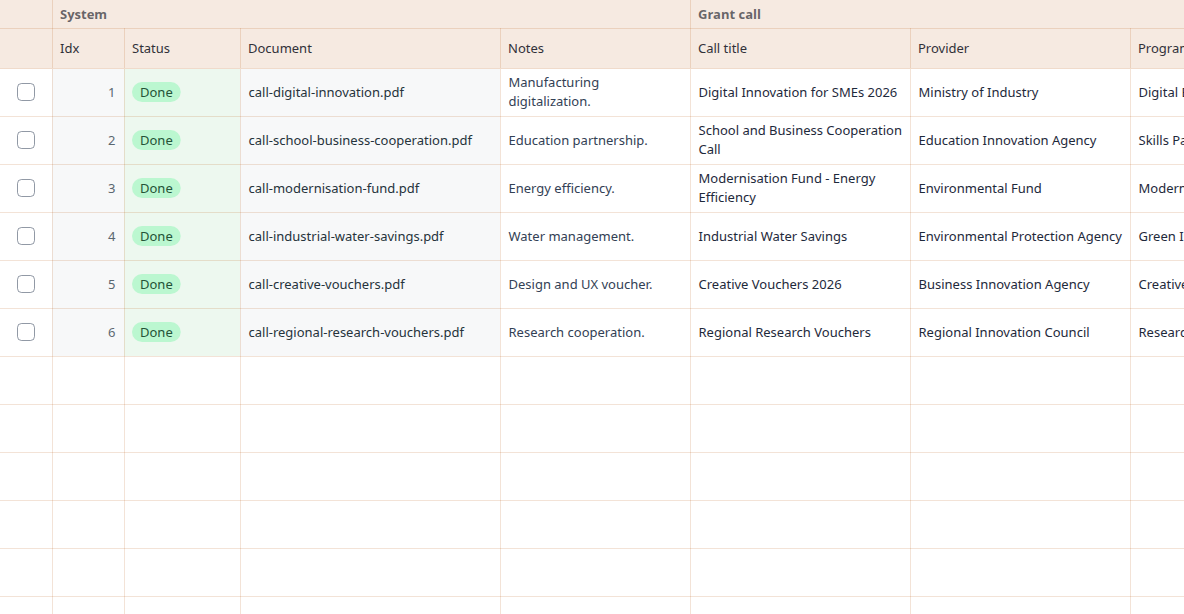
The template separates key tender and RFP information into reviewable fields:
Open template detail
Start with a prepared template for the workflow. The columns and instructions match the selected use case.
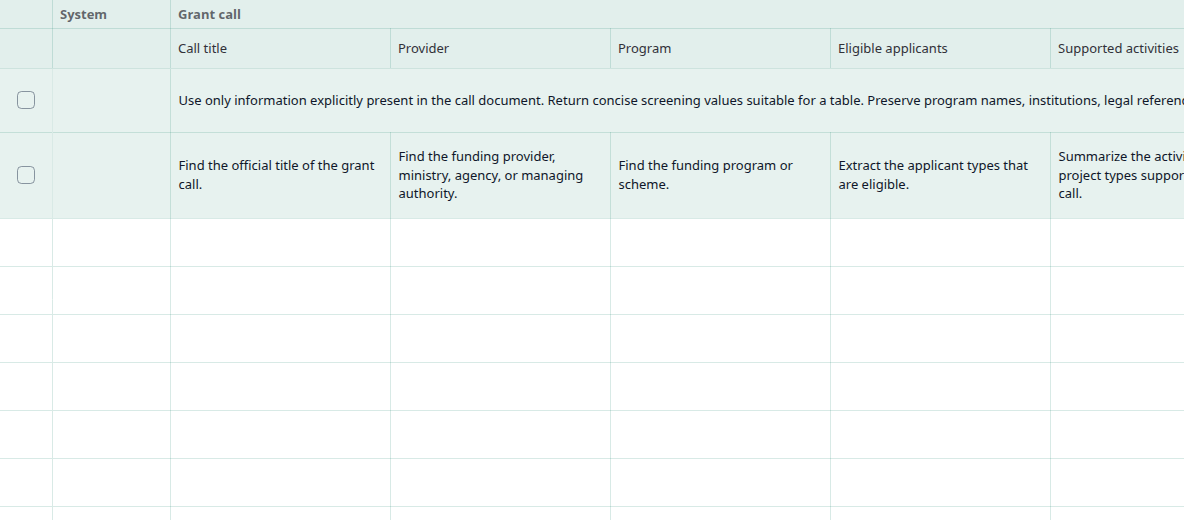
Each output column has its own instruction, so the result is structured table data instead of a loose summary. You can adjust the suggested columns or add custom ones for the fields you need.
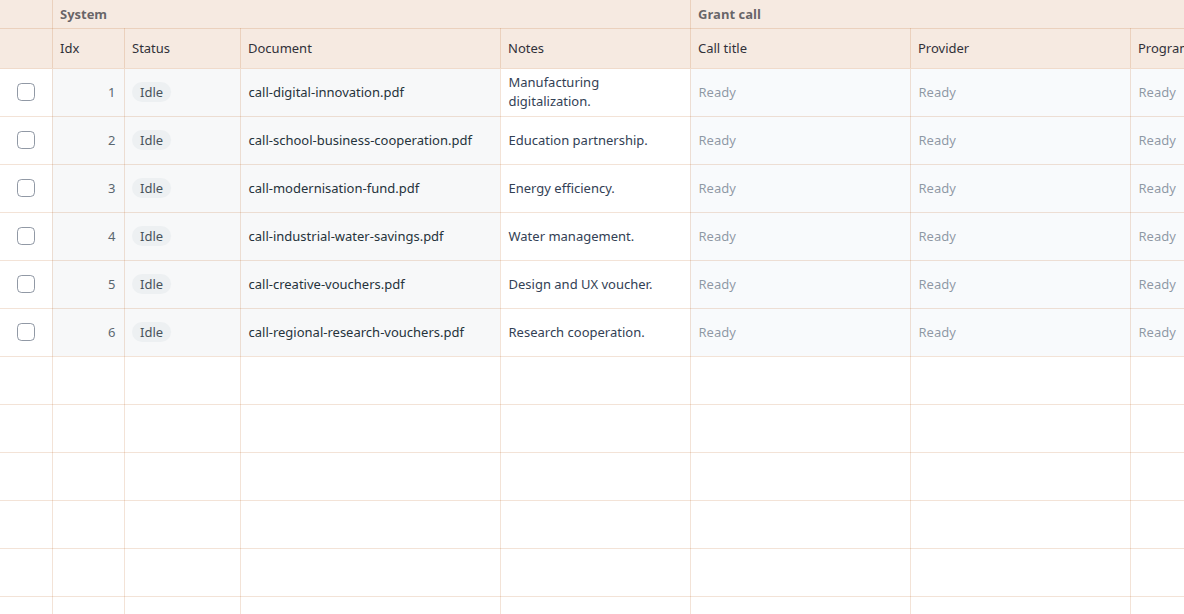
Upload files, add URLs, or paste text. Each primary source becomes one row by default; related attachments can stay on the same row.
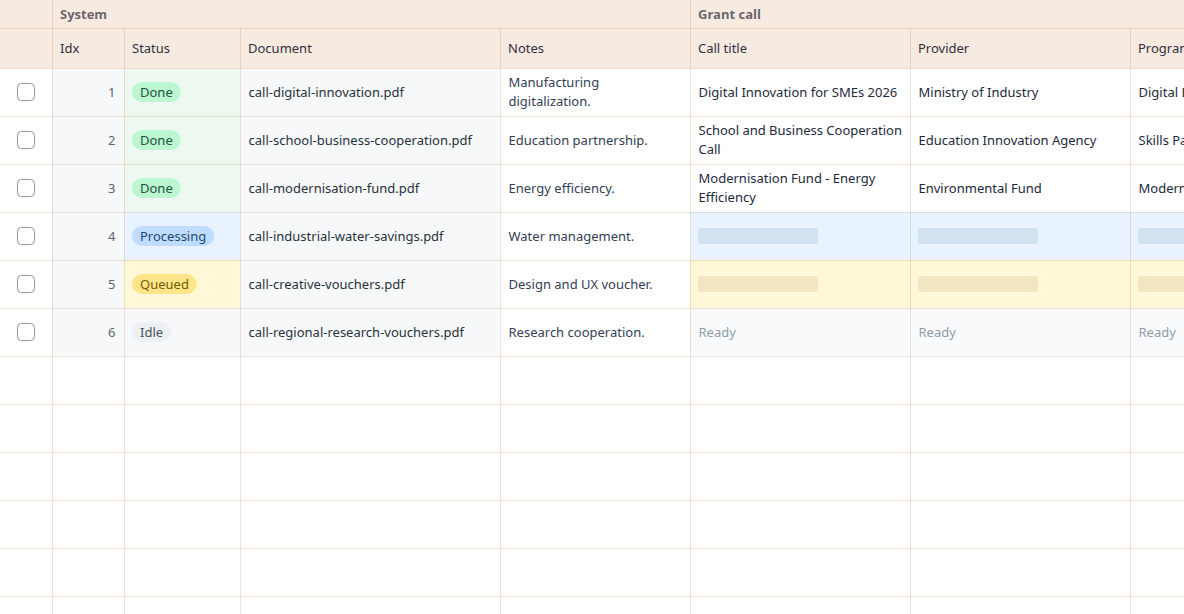
During processing, you can see what is done, what is waiting, and what is currently running. After completion, you can correct cells and export the table.
The demo uses synthetic file names, URLs, or text-source names and results. The same principle applies to your own primary sources; related attachments can be added to the same row.
The output is a table that works well in Excel or another review workflow. One row represents one primary source by default, related attachments can stay with it, and the columns describe the specific fields you want to extract. For tenders and rfps, this makes it easier to compare sources side by side without manual copying.
| Source | Buyer | Tender subject | Estimated value | Submission deadline | Eligibility requirements |
|---|---|---|---|---|---|
| rfp-it-support-city-of-leeds.pdf | Alpha Ltd | service package | EUR 12,500 | 2026-06-14 | stated in source |
| tender-equipment-regional-health-authority.pdf | Beta GmbH | equipment supply | EUR 9,840 | 2026-06-21 | value to verify |
| rfp-logistics-northern-region.pdf | Gamma LLC | review overview | EUR 14,190 | 2026-07-02 | fill after review |
Rowvia is useful for a first structured overview, review, and export. It should not replace accounting, legal, insurance, or other expert decisions, and important values should be checked against the source document.
Ordinary OCR usually only reads text. In a tenders and rfps workflow, the more useful result is getting values into the same columns across several sources, so they can be compared, filtered, and handed off as a table.
Yes. Rowvia prepares a review table where each primary source becomes one row by default, related attachments can stay with it, and the columns match the selected workflow.
Typical fields include Buyer, Tender subject, Estimated value, Submission deadline. You can adjust the columns to match your process.
No. The output is a reviewable working table. Important legal, accounting, insurance, or compliance values should still be checked by the responsible person.
Yes. You can use a prepared template as a starting point, then adjust columns or add your own questions for the fields you need to extract.
This page is mapped to concrete long-tail queries and links onward to the matching template, pricing, or technical documentation.
Open the demo, use the related template, or compare similar document scenarios.